

Search Results
234 results found.
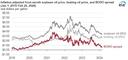
The price of compliance credits for biomass-based diesel and ethanol has decreased about 45% since the start of the year, when prices were already the lowest in about three years, according to the U.S. Energy Information Administration.

Sens. Sherrod Brown, D-Ohio, and Pete Ricketts, R-Neb., have introduced the Renewable Fuel for Ocean-Going Vessels Act, which aims to ensure that RINs generated for renewable fuel used by ocean-going vessels would be eligible for RFS compliance.

More than 1.89 billion renewable identification numbers (RINs) were generated under the Renewable Fuel Standard in January, up from 1.76 billion generated during the same month of 2023, according to a data released by the U.S. EPA on Feb. 15.
The U.S. EPA published updated renewable identification number (RIN) data on Jan. 18, reporting that nearly 23.75 billion RINs were generated under the Renewable Fuel Standard in 2023, up from 21.35 billion RINs generated in 2022.
More than 1.99 billion RINs were generated under the RFS in November, up from 1.95 billion generated during the same period of last year. Total RIN generation for the first 11 months of 2023 reached 21.55 billion.
EIA: New RFS volume targets facilitate RNG production

By U.S. Energy Information Administration
December 12, 2023
Data published by the U.S. EIA shows that cellulosic volume requirements established under the RFS have helped increase RNG production in the U.S, with RNG accounting for 84 percent of natural gas used in transportation last year.

The U.S. EPA on Nov. 16 released updated RIN data, reporting that nearly 2.11 billion RINs were generated under the RFS in October, up from 1.81 billion generated during the same month of last year.
Nearly 1.95 billion RINs were generated under the RFS in September, up from 1.73 billion generated during the same month of 2022, according to data released by the U.S. EPA. Total RIN generation for the first nine months of 2023 was at 17.41 billion.

The U.S. EPA on Aug. 21 released data indicating nearly 2.04 billion RINs were generated under the RFS in August, up from 1.84 billion generated in August 2022. Total RIN generation for the first eight months of the year reached nearly 15.45 billion.

Aemetis Inc. has announced the sale of 88,883 D3 renewable identification number credits (RINs), the company’s first commercial D3 RIN transaction under the RFS generated by the Aemetis Biogas Central Digester Project in California.

Aemetis Inc. has announced the sale of 88,883 D3 renewable identification number credits (RINs), the company's first commercial D3 RIN transaction under the RFS generated by the Aemetis Biogas Central Digester Project in California.
More than 1.98 billion RINs were generated under the RFS in July, up from 1.71 billion generated during the same month of last year. Total RIN generation for the first seven months of 2023 reached 13.4 billion.

More than 1.98 billion RINs were generated under the RFS in July, up from 1.71 billion generated during the same month of last year. Total RIN generation for the first seven months of 2023 reached 13.4 billion.
EPA: 2.04 billion RINs generated in June

By Erin Voegele
July 24, 2023
More than 2.04 billion RINs were generated under the RFS in June, up from 1.86 billion generated during the same month of last year, according to data released by the U.S. EPA. Total RIN generation for the first half of 2023 reached 11.39 billion.
More than 2.04 billion RINs were generated under the RFS in June, up from 1.86 billion generated during the same month of last year, according to data released by the U.S. EPA. Total RIN generation for the first half of 2023 reached 11.39 billion.

More than 2.11 billion renewable identification numbers (RINs) were generated under the Renewable Fuel Standard in May, up from 1.84 billion generated during the same month of last year, according to data released by the U.S. EPA on June 15.

More than 2.11 billion renewable identification numbers (RINs) were generated under the Renewable Fuel Standard in May, up from 1.84 billion generated during the same month of last year, according to data released by the U.S. EPA on June 15.
Nearly 1.84 billion renewable identification numbers (RINs) were generated under the Renewable Fuel Standard in April, up from 1.71 billion generated during the same month of 2022, according to data released by the U.S. EPA on May 18.
Aemetis Inc. announced on May 18 that the U.S. EPA has approved the Aemetis Biogas Services subsidiary’s renewable natural gas (RNG) production facility for the generation of D3 cellulosic biofuel RINs under the RFS.

Aemetis Inc. announced on May 18 that the U.S. EPA has approved the Aemetis Biogas Services subsidiary's renewable natural gas (RNG) production facility for the generation of D3 cellulosic biofuel RINs under the RFS.

Nearly 1.84 billion renewable identification numbers (RINs) were generated under the Renewable Fuel Standard in April, up from 1.71 billion generated during the same month of 2022, according to data released by the U.S. EPA on May 18.
The U.S. EPA has released data showing nearly 1.91 billion RINs were generated under the RFS in March, up from 1.82 billion generated during the same period of last year. Total RIN generation for the first quarter of 2023 reached 3.63 billion.

The U.S. EPA has released data showing nearly 1.91 billion RINs were generated under the RFS in March, up from 1.82 billion generated during the same period of last year. Total RIN generation for the first quarter of 2023 reached 3.63 billion.

Industry experts and ethanol producers explain what caused markedly high production margins in 2022—strong markets, exciting policy and good prices—while analyzing the first couple months of 2023 and predicting what's to come. Ethanol producers are coming off an undeniably strong year. 2022 was not devoid of challenges, but it was replete with landmark policy and marketplace dynamics that, on balance, allowed the vast majority of U.S. ethanol producers to do quite well financially. Mirroring that financial success this year would be like a pro baseball pitcher throwing back-to-back perfect games—it doesn’t happen—and, sure enough, the last quarter of 2022 and the first quarter of 2023 already reflect that. But this year’s margins may not disappoint, with at least some of last year’s margin-making factors still in play.

Sen. Pete Ricketts, R-Neb., pressed U.S. EPA Administrator Michael Regan on the agency's proposed biomass-based diesel RFS RVOs and its delayed action on a Midwest E15 petition during a March 22 Senate committee hearing.

Sen. Pete Ricketts, R-Neb., pressed U.S. EPA Administrator Michael Regan on the agency's proposed biomass-based diesel RFS RVOs and its delayed action on a Midwest E15 petition during a March 22 Senate committee hearing.

The U.S. EPA on March 16 released data showing that nearly 1.72 billion renewable identification number (RINs) were generated under the Renewable Fuel Standard in February, up from 1.54 billion generated during the same month of 2022.

The U.S. EPA on March 16 released data showing that nearly 1.72 billion renewable identification number (RINs) were generated under the Renewable Fuel Standard in February, up from 1.54 billion generated during the same month of 2022.

The U.S. EPA has released data showing more than 1.75 billion renewable identification number (RINs) were generated under the Renewable Fuel Standard in January, up from 1.59 billion that were generated during the same month of 2022.

The U.S. EPA has released data showing more than 1.75 billion renewable identification number (RINs) were generated under the Renewable Fuel Standard in January, up from 1.59 billion that were generated during the same month of 2022.
Advertisement

@ Copyright 2026 - BBI International - All rights reserved.