


Densification reduces transportation cost, improves storability and could open new markets. Are pellets the future for corn stover?

The Renewable Fuels Association has submitted comments to the California Air Resources Board voicing support for CARB's proposal to transition to a new version of the GREET model, but also recommending several additional improvements.

The Indian River BioEnergy Center, a cellulosic ethanol production center near Vero Beach, Florida, has completed a major turnaround, including technology upgrades, and the facility is now being brought back online.

The Iowa Renewable Fuels Association has announced Iowa motorists purchased 2.98 million gallons of E85 in the second quarter of 2014, according to data released by the Iowa Department of Revenue.

Ethanol producers need to learn their corn oil destination by working with marketers.

Several senators have asked U.S. Trade Representative Michael Froman asking to work with China to restore the flow of agricultural-related trade following the MIR 162 trade issues. Meanwhile, Cargill has filed a lawsuit against Syngenta.

The U.S. Energy Information Administration has published the September issue of its Short-Term Energy Outlook, slightly altering its ethanol production forecasts for this year and next year.

The Renewable Fuels Association implored Gina McCarthy, administrator of the U.S. EPA, to immediately address disparate fuel volatility regulations that hinder the sale and expansion of E15.

Red River Energy LLC's ethanol plant in Rosholt, South Dakota, is once again operating after sitting idle for approximately 18 months. As production continues, the company plans to increase capacity and complete several improvement projects.

Minnesota-based Buffalo Lake Advanced Biofuels recently restarted operations. The 18 MMgy plant, which was purchased out of bankruptcy in 2012, has undergone repairs and upgrades, including the installation of a new solids separation technology.

Corn Oil One has announced a major step toward the further processing of distillers corn oil by breaking ground on its new oil frac facility. The project, collocated with Southwest Iowa Renewable Energy LLC, is expected to be completed in early 2015.

Eco-Energy has announced the development of an ethanol unloading, storage, and outbound truck loading facility in Augusta, Georgia. This facility will serve the Augusta and Savannah markets in Georgia.

On Sept. 4, the Surface Transportation Board held a hearing to discuss rail service issues and delays. Among those offering testimony were two Midwest ethanol producers.

Using E15 gas rather than regular gas will reduce cancer-causing pollutants and smog in Chicago's air, says a new report that reviews and aggregates the results of independent research several institutions.
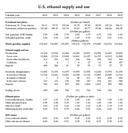
The University of Missouri's Food and Agricultural Policy Research Institute has published a mid-year update to its baseline agricultural report, which was prepared in January. The update includes revised forecasts for ethanol and corn production.

Iowa-based Summit Group has announced it will construct a corn ethanol production facility in Brazil. Groundbreaking on the $140 million project is expected within six months, with production beginning in early 2016.

Florida-based Protec Fuel has announced plans for a multi-phase rollout of E15 and E85 in the southern portion of the U.S. The company will initially open 28 stations offering both E15 and E85 across the South and Southeast regions of the country.

Only the October futures contract remains to be settled before the end of summer. With winter looming around the corner, sparing some time to learn a few lessons from the prior year and plan for the upcoming heating season is a prudent course.

The International Energy Agency has released its third annual Medium-Term Renewable Energy Market Report, which includes forecasts for global biofuel and renewable energy growth. For the first time, the report also includes an investment outlook.

August is proving to be a month of making new contract lows in nearby corn futures. Soybeans had the same type of trade but the contract lows were for new crop. Mild temperatures and scattered moisture despite a dry July triggered some sell-off.

With no approval to admit DDGS into China with Syngenta's MIR 162 trait it's still the big story in the coproduct market. Shippers have been working to find resolutions for tons of product on contract but not yet shipped.

Despite the focus on potential record corn production this growing season, corn futures are showing an amazing sense of stability at the end of August. This is creating the potential for light to moderate buyer support.

The EurObserv'ER has released its annual Biofuel Barometer, reporting that last year was the first time the consumption of biofuels in Europe decreased. The report notes the decline is essentially related to Spain and Germany.

CHS Inc.has announced a new program to better enable some of the 1,400 Cenex branded locations to meet consumer demand for E15. The Cenex Tank Program will cover a significant portion of the cost to purchase and install E15 storage tanks.

Despite challenges surrounding imports, China has accomplished a feat never before seen. According to Chinese and USDA data, China has imported more than 3 million metric tons each of corn, sorghum and DDGS this marketing year, which ends Aug. 31.

It's important to remind ourselves that ethanol is about revitalizing small towns and farms in rural America, writes Mike Bryan. A 50 MMgy ethanol plant will generate nearly $200 million in yearly revenue in DDGS and ethanol sales alone.

Brazil-based Cosan recently released financial results for the second quarter, reporting a 16 percent increase in EBITDA for its Raizen Energia business unit, which comprises its sugar, ethanol and cogeneration operations.

Abengoa's biofuels and bioenergy business saw a strong second quarter in the Americas, Abengoa CEO Manuel Sanchez Ortega said during the company's first half of 2014 earnings call on Aug. 12.

Malaysian officials recently agreed to permanently exempt imports of U.S. distillers dried grains with solubles and corn gluten meal from the nation's new sanitary and phytosanitary and inspection regulations for agricultural commodities.

Aemetis Inc. has released second quarter financial results, reporting revenue of $57.2 million, a 21 percent increase over the same quarter of 2013. The company also outlined future improvement plans in a recent business update conference call.
Advertisement

@ Copyright 2026 - BBI International - All rights reserved.