


A partnership between Sustainable Rail International and the University of Minnesota is working to revitalize an old world transportation technology with a new world approach to biomass.

The most oil-dependent state in the U.S. is taking a step toward renewable energy with construction of a 24 MW biomass power plant.

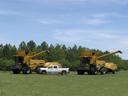
With the purchase of two new pieces of equipment Feedstox is prepared to begin executing contracts to harvest biomass in less than two weeks, says Jeff Roskam, CEO of the Kansas Alliance for Biorefining and Bioenergy.

Feedstox, a Kansas Alliance for Biorefining and Bioenergy company, has purchased seven new pieces of agricultural equipment for what it's dubbing as the nation's most advanced harvesting fleet. The equipment is Challenger brand made by AGCO Corp.
The Montana plant produces biobased flavors and fragrances that meet higher standards

Vermont has become the first U.S. state to ban fracking, or hydraulic fracturing, for natural gas. Gov. Peter Shumlin signed legislation on May 18 and at the same time signed several other pieces of energy-related legislation.
KiOR Inc. has announced that its first commercial-scale plant is now 100 percent mechanically complete, an achievement reached ahead of schedule. President and CEO Fred Cannon made the announcement as part of the company's first-quarter financials.


Massachusetts' final RPS regulations could quash biomass energy in the state
Arizona-based algae technology company Heliae broke ground on a commercial demonstration facility that will showcase the scalability and economics of its proprietary algae technology platform. Heliae plans to build many more plants in coming years.

The U.S. Senate Committee on Energy & Natural Resources held a hearing May 17 to gather testimonial regarding S. 2146, the Clean Energy Standard Act of 2012.

American Ethanol's partnership with NASCAR has extended with an official sponsorship of two upcoming NASCAR Camping World Truck Series races. The races will be held July 14 and Sept. 15 at the Iowa Speedway.

BIO and Agriculture Energy Coalition members told a hearing that Farm Bill Energy Title programs have had a significant impact on rural economies and blossoming renewable energy industries since their creation in 2002, urging continued funding.
Military Renewables Plan: A Bioenergy Booster

By Roger Stark, Daniel Simon, Darin Lowder
May 22, 2012


Dangers of Spin
May 21, 2012
It seems like every advocacy group is dedicated to sending out multiple news releases and commissioning reports to put a favorable spin on information backing its positions. Their credibility can be fatally affected if they go too far.

Before the U.S. House of Representatives Agriculture Committee concluded a series of hearings on programs potentially affected by a new Farm Bill, the Subcommittee on Conservation, Energy and Forestry listened to testimony about BCAP.

North Carolina-based Quality Recycling is bringing to the American electricity market a boiler technology that has a 99.9 percent total carbon burn out.

An ICM Inc. designed and built cooking fuel ethanol plant is now open in Dondo, Mozambique--providing area residents with cassava-based ethanol, a cleaner alternative to cooking with charcoal.
Two proposed farm waste projects in Maryland could link together, one providing fuel and the other providing power.

A recently released online video series on biomass harvest and retention issues provides perspective on how woody biomass can be used for energy while maintaining forest habitat, soils and water.
Propel Fuels opens Clean Mobility Center in California

By Propel
May 17, 2012
Propel Fuels is redefining the American gas station with the launch of the company's first Clean Mobility Center in Fullerton, Calif. Beyond fuel, the stations enable drivers to offset carbon, improve fuel economy, tune bicycles and recycle.

An anaerobic digestion (AD) project planned for a dairy farm in Massey, Md., will convert dairy manure and local food waste substrates into renewable compressed natural gas.

The Iowa Energy Center recently awarded three grants to research projects focused on improving thermochemical conversion of biomass to biofuels and renewable chemicals.
The legislation, titled the "Qualifying Renewable Chemical Production Tax Credit Act of 2012," or H.R. 4953, would establish a production tax credit of 15 cents per pound of eligible content of renewable chemicals produced during the taxable year.

The Massachusetts Department of Energy Resources held a webinar May 16 to explain changes made in its proposed final woody biomass regulations released at the end of April.
Sustainability, carbon body approves US firm to certify biofuels

By Scientific Certification Systems
May 16, 2012
Scientific Certification Systems is the first certification body in the United States to be accredited by the International Sustainability & Carbon Certification (ISCC) biofuel certification system.
Advertisement

@ Copyright 2026 - BBI International - All rights reserved.