

A team of researchers at Tulane University have discovered a unique bacterial strain of clostridia, coined TU-103, that has the ability to convert cellulosic materials into biobased normal butyl alcohol, or n-butanol, in the presence of oxygen.

Ethanol production is on the rebound following a bout of reduced output during the extreme heat of July and early August. Between May 27 and June 3, U.S. ethanol producers pumped out 915,000 barrels of ethanol per day, according to EIA statistics.
Poet offers certified antibiotic-free DDGS

August 30, 2011
Poet LLC announced Aug. 30 it has adjusted its production process in order to sell certified antibiotic-free DDGS. Poet tested its new process with egg-farming customers with support from the United Egg Producers.

The Jackson Laboratory, a genetics research facility in Bar Harbor, Maine, installed a new 4,000-square-foot biomass energy center that utilizes European technology to create power from wood powder.

PurposeEnergy Inc.'s Biphase Orbicular Biodigester is ideally suited to process higher-solid waste than traditional anaerobic digesters. With that capability in mind, the company is focusing on the brewery market, and its waste streams.

A BTEC webinar on Aug. 30 tackled issues surrounding how the public views biomass energy projects. The webinar discussed misconceptions about biomass energy and how challenges to projects can be overcome through outreach and education.

Biomass leaching paired with torrefaction yields a densified biomass fuel ideally suited in many ways for biopower production, according to Luis Cerezo of the Electric Power Research Institute, who participated in a DOE webinar on Aug. 30.
Using a $25 million U.S. DOE award, UOP LLC, a Honeywell company, announced Aug. 30 that it has begun construction in Hawaii of a biofuels demo unit to convert forest residuals, algae and other cellulosic biomass into green transportation fuels.
Through subsidiary Bluewater Biochemicals, BioAmber has identified Sarnia, Ontario, Canada, as the site for its first North American biobased succinic acid production facility. The facility will have an initial annual capacity of 17,000 metric tons.
Navy Secretary Ray Maybus held a press conference to inform the private sector that a request for information has been issued on how to leverage capital markets to establish a commercially viable drop-in biofuels national market. They want ideas.
Wind projects provide a model
August 29, 2011
Investors with an appetite for loss, common in wind projects, may be what's needed to see CHP take hold in the ethanol industry.

Maine Energy Systems, in Bethel, Maine, is preparing for a spike in pellet boiler sales, as the Maine Department of Environmental Protection is the first state in the nation to accept EU emissions testing as comparable to U.S. federal standards.

Covanta Energy partnered with the municipal regions of Durham and York in Ontario, Canada, to break ground on an energy-from-waste (EfW) facility in August. Covanta will be designing, constructing and operating the Durham York Energy Centre.

Recent independent testing and analysis of the biomass gasification system installed on the University of Northern British Columbia campus shows the plant is one of the cleanest biomass facilities operating in North America.
Aquaflow Bionomic, a New Zealand-based algae technology developer, is taking a broad approach to algae-to-fuel development, one the company's director says may include nonalgae feedstocks. It's now working with CRI Catalyst Co. on the IH2 process.
The visit aimed to highlight the Obama Administration's efforts to support the creation and production of biobased products in order to create jobs, add value to agricultural commodities, and reduce America's dependence on foreign oil.
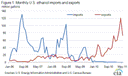
A recent report from the U.S. DOE's Energy Information Administration confirms what many in the ethanol industry already knew -- exporting ethanol has become big business.
Biomass Industry Zeros in on Washington
By Rona Johnson
August 26, 2011
As the government prepares to make cuts to try to balance the budget, the renewable industry needs to make sure its message is heard in D.C.
Monticello said while ethanol may not be a focus of the collaboration, the alcohol acts as a viable springboard for getting to the basic building blocks of producing chemicals such as isoprene, which is of specific interest to GlycosBio.

Propel Fuels signed a deal to co-locate its Clean Fuel Point alternative fuel dispensers at more than 80 of PC&F's 300 gas stations and convenience stores located in California, Washington Oregon and Colorado.

About 225 people attended ACE's “Rooted in America� conference Aug. 22 -24 in Des Moines, Iowa, where Sen. Tom Harkin promised he'd fight vigorously to protect RFS2 and predicted that the biofuels industry would exceed the 36-billion-gallon target.
U.S. Grains Council road show blitzes Southeast Asia

By U.S. Grains Council
August 25, 2011
The U.S. Grains Council took its “DDGS Use in Poultry Road Show� to nutritionists, feed mill managers and quality control staff across Malaysia, Thailand and Indonesia this summer to provide technical training and encourage optimal use.

The American Biogas Council is looking for support for the Waste-to-Energy Technology Act of 2011 (H.R. 66), which would provide a 30 percent tax credit to eligible waste-to-energy facilities using municipal solid waste or sewage sludge.
Vertically-integrated algae developer Aurora Algae has received $22 million in funding in a round led by Oak Investment Partners and other existing investors, along with an undisclosed foreign strategic investor. To date it has raised $72 million.
Ineos announced this month that its joint-venture project, Ineos New Planet BioEnergy, finalized $75 million in private financing utilizing the USDA loan guarantee program for its new Indian River BioEnergy Center located in Vero Beach, Fla.
Is it too early to include algae in the billion-ton update, or is there something more nefarious going on?
Sustainable Development Technology Canada issued its annual call for applications under the $500 million NextGen Biofuels Fund created by the government to support the establishment of innovative demonstration-scale biorefining facilities.

USDA researchers say they have developed a cost-effective method of determining the ethanol potential of energy grasses that could be used to evaluate the feedstock at the ethanol plant's loading dock using near-infrared sensing.
Federal GHG reporting tool opens for business

August 24, 2011
EPA's electronic tool for reporting GHG emissions, dubbed e-GRRT, is ready for use. Any stationary source emitting more than 25,000 tons per year of CO2 equivalent is required to report its emissions data, which includes most ethanol producers.
Advertisement

@ Copyright 2026 - BBI International - All rights reserved.