


The attorney generals of seven Midwest states are urging the Biden administration to take action on petition filed by a bipartisan coalition of governors in April 2022 seeking a permanent solution to year-round E15 sales within their states.

The U.S. Department of Energy on Jan. 26 awarded $118 million to 17 projects to accelerate the production of sustainable biofuels for America's transportation and manufacturing needs. The projects were selected under a FOA issued in mid-2022.

Both houses of the Illinois General Assembly on Jan. 10 approved a legislative package that, in part, creates a $1.50 per gallon tax credit for SAF. The legislation must now be signed by Illinois Gov. JB Pritzker.

The U.S. Grains Council's Southeast Asia and Oceania office recently spent a week in Ilocos Norte, Philippines, surveying community ethanol development programs and research infrastructure with MOU partner Mariano Marcos State University.

The American Coalition for Ethanol Chief Marketing Officer Ron Lamberty joined the U.S. Grains Council at the India Auto Expo, Asia's largest automotive show, to promote ethanol implementation across the country.

As higher ethanol blends like E15 and E85 continued to expand in the marketplace in 2021, thirty-five states and the District of Columbia blasted through the so-called 10 percent ethanol “blend wall,� according to the RFA.

The U.S. EPA on Jan. 19 released data showing that 10 new SRE petitions have been filed under the RFS over the past month. A total of 22 SRE petitions are now pending, including two that were previously declared a as ineligible.

The U.S. EPA has announced 1.89 billion RINs were generated under the RFS in December, down from 2.02 billion generated in December 2021. Total RIN generation for 2022 reached nearly 21.27 billion, up from 19.93 billion generated in 2021.

Working continuously to expand global markets for ethanol, the U.S. Grains Council has identified key priority and second tier markets to grow demand and, ultimately, help U.S. producers export four billion gallons of ethanol by 2025.

The ethanol industry is poised for continued success in 2023, and the Renewable Fuels Association remains focused on solidifying year-round access to E15, building export markets and moving incrementally closer to net-zero carbon emissions by 2050.

The European Commission has published its annual EU agricultural outlook, which includes projections for biofuel use through 2032. The outlook predicts stable biodiesel use in the medium-term, with increased ethanol use through 2030.

The IEA's recent Renewables 2022 report provides information on ethanol and other sources of renewable energy that can help countries accelerate their transition to net zero, according to the U.S. Grains Council.

The U.S. EPA on Jan. 12 approved a fuel pathway filed by LanzaJet Inc. under the RFS that will allow the company's biorefinery near Soperton, Georgia, to generate D4 RINs for renewable jet fuel and renewable diesel produced from sugarcane ethanol.

The Renewable Fuels Association on Jan. 12 congratulated former Nebraska Gov. Pete Ricketts on his appointment to the U.S. Senate by new Gov. Jim Pillen. Ricketts takes the place of former Sen. Ben Sasse, who recently resigned.

Growth Energy, the USGC and the RFA congratulated India for recently achieving its ethanol fuel blending target of 10 percent, five months ahead of schedule. The three groups issued the statement ahead of India's upcoming Auto Expo 2023.

The DOE has released the U.S. National Blueprint for Transportation Decarbonization, which focuses on achieving net-zero emissions in the transportation. The blueprint, in part, discusses the role sustainable fuels can play in reaching that goal.

Growth Energy released its federal policy priorities for 2023 on Jan. 9, outlining an ambitious agenda to lower prices at the pump, lower carbon emissions, and increase consumer access to higher blends of ethanol.

The U.S. EIA has maintained its forecast for 2023 fuel ethanol production and blending its latest Short Term Energy Outlook, released Jan. 10. The agency predicts a slight increase in both ethanol production and consumption for 2024.
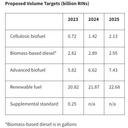
The U.S. EPA on Jan. 10 held a virtual public hearing to gather public comments on its proposed RFS “set� rule. The ethanol industry is generally supportive of the proposal, while biomass-based diesel groups are calling for improvements to the RVOs.

The call for speaker presentation ideas is now open for the 2023 International Fuel Ethanol Workshop & Expo (FEW). The three-day event is scheduled to take place June 12-14, 2023 in Omaha, Nebraska.

A new survey of registered voters shows robust support for ethanol and the Renewable Fuel Standard, while also revealing significant opposition to policies that ban liquid fuels or mandate electric vehicles, according to the RFA.

The STB is seeking nominees to fill nine vacancies on its Rail Energy Transportation Advisory Committee. One of those vacancies is to be filled with an individual representing biofuel feedstock growers or providers and biofuel refiners.

The government of Japan is inviting comments on proposed biofuel standards for fiscal years 2023 through 2027. The proposal also includes updated carbon intensity (CI) values for both U.S. corn-based ethanol and Brazilian sugarcane-based ethanol.

ACE has announced its 12th annual Washington, DC Fly-in and Government Affairs Summit will take place March 29-30, 2023. Fly-in prioritiies include year-round E15, technology-neutral clean fuels policy, and the Next Generation Fuels Act.

The White House OMB on Jan. 4 published its 2022 Fall Unified Agenda and Regulatory Plan, confirming the expected timeline on federal rulemakings related to the Renewable Fuel Standard, E15 sales and the Biopreferred program.

The Senate has confirmed Doug McKalip and Alexis Taylor to posts critical to agriculture trade. McKalip is now chief agricultural negotiator at the Office of the USTR and Taylor is USDA under secretary for trade and foreign agricultural affairs.

The government of Brazil on Dec. 23 announced it will extend its suspension of the import tariff on ethanol through at least the end of January. The RFA is calling the extension “a positive first step toward a permanent resolution."

The U.S. EPA on Jan. 3 released an external review draft of its third triennial report to congress on biofuels and environment for public comment. A 60-day public comment period will be open through March 6.

The U.S. Department of Energy Bioenergy Technologies Office has announced its intent to issue two funding opportunity announcements (FOAs) in early 2023 focused on algae crop production and cellulosic biomass conversion.

Three projects have been selected for funding under a U.S. DOE interagency agreement with the Minority Serving Institution STEM Research & Development Consortium. The projects focus on algae, waste feedstocks, and catalyst development.
Advertisement

@ Copyright 2026 - BBI International - All rights reserved.