

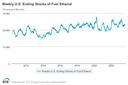
U.S. fuel ethanol production was down 2 percent the week ending Aug. 18, according to data released by the U.S. Energy Information Administration on Aug. 23. Ethanol stocks were down nearly 3 percent while exports were up 19 percent.

Reps. Jasmine Crockett, D-Texas, and Max Miller, R-Ohio, on Aug. 18 introduced the Farm to Fuselage Act, legislation that aims to update the Farm Bill to facilitate increased domestic production of sustainable aviation fuel (SAF).

Fluid Quip Technologies has announced that its patented Distillers Corn Oil (DCO) Technology is achieving record distillers corn oil yields for Ace Ethanol in Stanley, Wisconsin, with increases of over 20 percent above historical rates.

Growth Energy filed a motion to intervene in the U.S. Court of Appeals for the Eleventh Circuit in response to the Hunt Refining Company’s lawsuit seeking to reverse the U.S. EPA’s decision to reject unwarranted SREs.
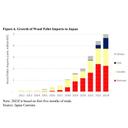
Japan has been dramatically increasing its wood pellet imports for its feed-in-tariff (FIT) program, with wood pellet imports expected to reach an estimated 4.25 million bone-dry tons this year, according to a report filed with the USDA.

Brightmark RNG Holdings LLC, a joint venture partnership between Chevron U.S.A. Inc. and a subsidiary of Brightmark LLC has announced the delivery of the first renewable natural gas (RNG) from its Larson Project in Okeechobee County, Florida.

Reps. Jasmine Crockett, D-Texas, and Max Miller, R-Ohio, on Aug. 18 introduced the Farm to Fuselage Act, legislation that aims to update the Farm Bill to facilitate increased domestic production of sustainable aviation fuel (SAF).
USDA expects no actions under Feedstock Flexibility Program for crop year 2022

By Erin Voegele
August 22, 2023
The USDA’s Commodity Credit Corp. announced on Aug. 21 that it does not expect to purchase and sell sugar under the Feedstock Flexibility Program for crop year 2022, which runs from Oct. 1, 2022 through Sept. 30, 2023.

Caramuru, a Brazilian agribusiness company, on Aug. 16 announced it has begun selling soybean-based ethanol produced at its processing complex in Sorriso, Mato Grosso, a city located in the west-central region of the country.

The U.S. Department of Energy's national laboratories are helping companies advance sustainable aviation fuel (SAF) technologies by offering customizable pilot plants, laboratory equipment, and even supercomputers.

The U.S. Department of Energy's national laboratories are helping companies advance sustainable aviation fuel (SAF) technologies by offering customizable pilot plants, laboratory equipment, and even supercomputers.

Topsoe was selected by Marathon Petroleum Corp. as the technology provider for renewable fuels production at the Martinez Renewable Fuels Facility in California. The facility utilizes Topsoe's HydroFlex technology to produce renewable diesel.
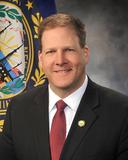
New Hampshire Gov. Chris Sununu on Aug. 18 vetoed HB 142, a bill that aims to support future operations at Burgess BioPower, a 75-megawatt (MW) biomass-fired power plant located in Berlin, New Hampshire.

The U.S. EPA’s Science Advisory Board is scheduled to discuss draft commentary on the agency’s recently finalized Renewable Fuel Standard “set” rule during a public meeting scheduled to be held Sept. 21-22 in Washington, D.C.
Summit Carbon Solutions submits revised pipeline permit application to North Dakota PUC

By Erin Voegele
August 21, 2023
Summit Carbon Solutions on Aug. 19 announced it has submitted a petition for reconsideration for the company’s pipeline permit application to the North Dakota PUC. Summit said the petition addresses previously raised concerns.

Vietnam has revised the Most-Favored-Nation (MFN) tariff on ethanol, reducing it from 15 to 10 percent. The new tariff rate went into effect on July 15, 2023, and applies to both undenatured and denatured ethanol.

The U.S. Department of Energy has awarded $34 million to 19 industry- and university-led research projects that will advance cutting-edge technology solutions for clean hydrogen. Several of the projects address biomass-to-hydrogen technologies.

Cummins Inc. and Chevron U.S.A. Inc., a subsidiary of Chevron Corp., are expanding their previous strategic collaborationon hdyrogen and RNG to include other liquid renewable fuels, such as biodiesel, renewable diesel and renewable gasoline.

The U.S. EPA's Science Advisory Board is scheduled to discuss draft commentary on the agency's recently finalized Renewable Fuel Standard “set� rule during a public meeting scheduled to be held Sept. 21-22 in Washington, D.C.
More than 1.98 billion RINs were generated under the RFS in July, up from 1.71 billion generated during the same month of last year. Total RIN generation for the first seven months of 2023 reached 13.4 billion.
EPA: No new SREs filed under the RFS
August 18, 2023
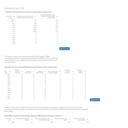
The U.S. EPA published updated small refinery exemption (SRE) data on Aug. 17, reporting that no new SRE petitions have been filed under the Renewable Fuel Standard in the past month. Only two SRE petitions remain pending.

Braskem and SCG Chemicals are forming a joint venture that aims to produce bio-ethylene from bio-ethanol dehydration and to commercialize I’m green biobased polyethylene (PE), using the EtE EverGreen technology.

In late July, the U.S. Grains Council’s Mexico office sponsored a pet food seminar where industry representatives in the country learned more about the use of sorghum and DDGS as ingredients for pet food.


The role of biofuels in the transition from a fossil-based economy to carbon neutrality has been the subject of intense and often misinformed debate, but optimism is growing that Europe could soon move to a more constructive discussion.

Southwest Airlines has launched of a new, innovative option for eligible corporate customers looking to support SAF. Eligible corporate customers can now purchase Customer SAF Claims and/or carbon offsets directly within Southwest Business Assist.

The U.S. EPA published updated small refinery exemption (SRE) data on Aug. 17, reporting that no new SRE petitions have been filed under the Renewable Fuel Standard in the past month. Only two SRE petitions remain pending.
More than 1.98 billion RINs were generated under the RFS in July, up from 1.71 billion generated during the same month of last year. Total RIN generation for the first seven months of 2023 reached 13.4 billion.

International Airlines Group and Microsoft have signed the largest co-funded purchase agreement for sustainable aviation fuel (SAF) emissions reductions globally, where both parties are funding part of the cost of the supply.
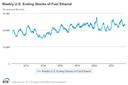
U.S. fuel ethanol production was up nearly 5 percent the week ending Aug. 11, according to data released by the U.S. Energy Information Administration on Aug. 16. Ethanol stocks were up more than 2 percent, with exports up more than 14 percent.
Advertisement

@ Copyright 2026 - BBI International - All rights reserved.